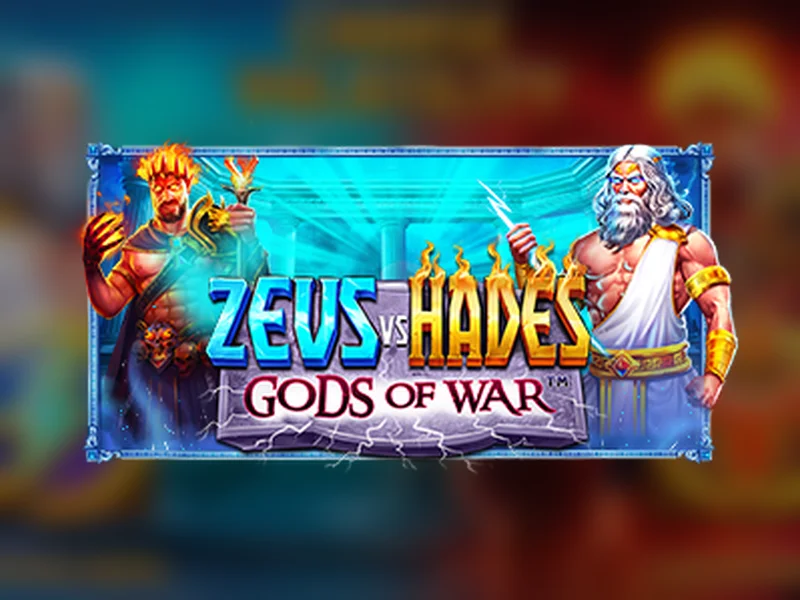
Zeus vs Hades Gods of War
- RTP 96.07%
- High
- 15,000x
- Bonus Buy
- Demo available
Zeus vs Hades Gods of War lets a player pick between two published volatility modes, with expanding wilds to 100x and a 15,000x maximum.
Play Demo
A choice before the first spin
Most slots decide their character at the design desk, and Zeus vs Hades Gods of War hands the decision to the player. A switch in the interface offers two named modes, Olympus and Hades, and the game plays to a different temper under each. Pragmatic Play released the game on 22 May 2023, under an announcement saying the studio “empowers player choice”. The official page goes further and states that “players’ choices affect the look and volatility of their game”. A choice with published consequences is rarer than it should be, and it is the reason this review runs longer than most.
The two modes on paper
Olympus is the frequent side of the switch. Its bonus arrives more often and its average outcome sits lower, by the studio’s own description. Hades runs the opposite bargain, with rarer bonuses and heavier average outcomes. Its free spins carry a written assurance of expanding wilds. The announcement grades the pair separately. It states “the volatility is high in Olympus” and “the volatility is very high in Hades”. Both modes share the sheet, the symbols and the limit, so the switch moves temperament rather than furniture. The configuration prices the two tempers separately as well, and the next section reads those figures.
What the disclosures say
The official page publishes an RTP of 96.07% for the game. The configuration behind the studio’s demo prints two base figures, 96.07% and 96.05%, one for each mode, without labelling which owns which. This catalogue records the pair as published and notes the missing label, because precision about sources is the point of these pages. Four purchase routes follow at 96.14%, 96.08%, 96.04% and 96.01%, a wider bought menu than any stablemate reviewed here carries.
The announcement describes an epic sheet of 5×5 reels and 15 paylines. The configuration, for its part, charges the stake as 10 coins of 0.01 to 25.00 each. Both statements are official rather than rivals. The practical reading is 15 lines of play billed at 10 coins, from 0.10 to 250.00 credits a spin. Lower operator versions, where they exist, go unlisted on every official surface, the studio’s standing habit. The version a casino runs decides the price, and its own paytable is where that decision is printed.
Wilds that stretch and stay
The engine under both gods is a payline game with one dominant symbol, the expanding wild. A wild that lands stretches to fill its reel, in the pattern filed under Expanding Wilds. A single wild can carry a multiplier of up to 100x. Wilds can arrive on all 5 reels, and multiplied wilds meeting across a line are the game’s route to its heaviest payments. The base sheet runs 5 rows deep, which gives a stretched wild its reach, and wins form along the 15 lines in the way described under Paylines.
Entry to the bonus asks for 3 scatters and pays out in 10 free spins. Through the round the expanding wilds hold their places, the behaviour filed under Sticky Wilds, and the board fills rather than churns. Hades adds its written assurance inside the round, and Olympus plays the same rules at its own gentler weight. The page frames the whole design as an invitation to “battle for a 15,000x maximum win”, and the limit is the same whichever god is chosen.
Four doors, four prices
The purchase menu deserves its own paragraph, because its four printed returns straddle the base game. Two of the four sit above both base figures, at 96.14% and 96.08%, and two sit below, at 96.04% and 96.01%. A purchase priced above the base game is a genuine oddity, and the rules print it without comment. The rules price each option at the point of sale. A player can hold the four returns against the two base figures before paying. No ante option exists in this game, so the choice is the clean pair of waiting or buying, where the market allows the latter.
What the two figures buy
Where other games word their volatility, this one prices it twice over. Set the two base modes side by side and the price of temperament becomes visible for once. Most studios publish one figure and let the word high do the rest, which prices nothing. Their returns sit $0.02 apart per $100 staked, whilst their two limit frequencies sit a third apart. For close to the same price, one temperament reaches the limit a third more often than the other, and the exchange is printed rather than implied. No other game in this catalogue prices its own personality so legibly, and that fact carries most of the score below.
What it costs to play
The published 96.07% makes this the dearest game in this catalogue so far. A long run of $1 spins settles each $100 down to $96.07, with $3.93 retained. The second base figure shaves a further $0.02 from the price. Players are paying $0.43 more per $100 than a 96.50% stablemate charges, and the sheet gives them the mode lever in return. The configuration gives the 15,000x limit two frequencies, one per mode, at 1 in 1,766,784 spins and 1 in 1,335,113. A limit quoted at two odds is unique in this catalogue, and it is the mode choice expressed in a single line of figures.
The sequel and the family
The game stands alone rather than inside a named series, though its Greek staging places it beside the studio’s grid flagships on any shelf. The studio’s own news feed announced a follow up in February 2026, named for the same pair with a 250 in the title. The follow up reads as an endorsement of the formula. Nothing about the sequel changes this review, which reads the 2023 game as shipped. Players who want the mythology without the payline engine have the Gates of Olympus family, reviewed at length in this catalogue. The two designs share a god and nothing else of consequence, and the pick between them is a pick of engine.
Disclosure grade and score
Disclosure sits at the top of the B band. Six mode and purchase returns, two limit frequencies and two volatility gradings are printed, the fullest sheet in this catalogue. The unlabelled pairing of base figures to modes, and the usual silence on operator versions, are what hold the grade short of an A. The game stands at 8 of 10, the highest mark here so far. It earns the mark by making the player’s one real decision legible, and by pricing both answers in the open. The reservation is the base price, since 96.07% buys the lever and nothing else. Unless a player means to pull the lever, they are simply paying more for the same limit.
One check before you play
- Confirm which mode the lobby opens by default and read its paytable figure there, because the two base returns differ and the label is the player’s to check.
- Where a purchase menu is offered, hold each option’s printed return against the base pair, since two of the four price above it and two below.
Sources
This review was written against the records that follow.
What counts as proof on this site is defined in the Review Method.
Frequently asked questions
What is the difference between Olympus and Hades in this game?
Olympus runs the more frequent bonus at a lower average outcome, and Hades the rarer bonus at a heavier one. The announcement grades Olympus as high volatility and Hades as very high, and Hades assures expanding wilds in its free spins.
What RTP does Zeus vs Hades Gods of War publish?
The official page prints 96.07%. The configuration prints two base figures of 96.07% and 96.05% for the two modes, and four purchase returns running from 96.01% up to 96.14%.
How do the free spins work?
3 scatters open 10 free spins. The expanding wilds hold their reels for the rest of the round. They carry multipliers of up to 100x, and the Hades mode assures them in its spins.
What is the maximum win in Zeus vs Hades Gods of War?
The page states a 15,000x maximum. The configuration quotes it at two frequencies, 1 in 1,766,784 spins and 1 in 1,335,113, one for each of the two modes.